P-BFMPerceptive Behavioral Foundation Modelsfor Humanoid Control via Unsupervised Reinforcement Learning
A single humanoid policy that adapts its motion to the terrain it sees.

The idea
Same intent.
Different terrain.
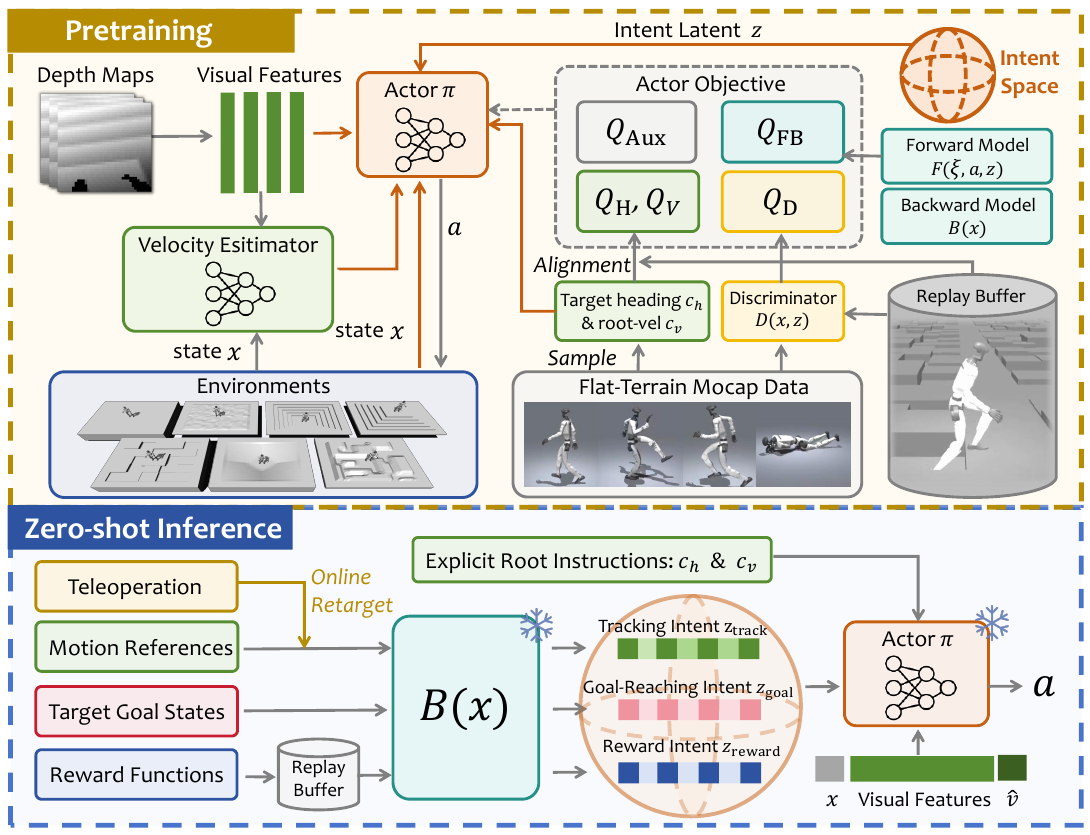
P-BFM separates what behavior to perform from how to execute it. Depth perception guides terrain adaptation; explicit heading and velocity instructions guide root motion.
One frozen policy supports motion tracking, goal reaching, reward inference, and teleoperation on a Unitree G1.
How P-BFM worksTerrain adaptation
One walking intent, varied terrain.
Changes in gait and footholds emerge without terrain-specific motion demonstrations.

01 / Demonstrations
Goal reaching
5 videosInput A target body state.
Watch how the robot approaches that state on flat ground, slopes, and stairs.
Show remaining 3 videosShow fewer videos
02 / Demonstrations
Motion tracking
5 videosInput A reference motion.
Watch walking, dancing, and cartwheel motions adapted to the terrain.
Show remaining 3 videosShow fewer videos
03 / Demonstrations
Reward inference
Input A reward function for forward speed and pelvis-to-foot height.
Watch the resulting walking behavior.
- Velocity target
- 1 m/s
- Height target
- 0.4 m
Reward targets, not measured outcomes.
04 / Demonstrations
Teleoperation
5 videosInput Live human motion through online retargeting.
Watch the robot follow the operator’s movements on stairs and platforms.
Show remaining 3 videosShow fewer videos
Method
From behavioral intent to physical action.
Encode the intent
A forward–backward representation maps motion references, target states, and rewards into a shared behavioral space.
Perceive the terrain
The actor uses depth observations to adapt whole-body execution to its surroundings.
Guide root motion
Explicit Root Instructions specify heading and planar velocity alongside the behavioral latent.